What Makes a School AI-Ready? Building Future Classrooms
Artificial Intelligence (AI) is continuously changing our world. Voice assistants, generative AI like ChatGPT and recommendation algorithms have already become a part of everyday life. Education is one of the sectors where AI’s impact is particularly significant. All over the world, many schools are considering the implementation of AI in education to improve the learning experience, individualise the learning process, relieve teachers from administrative tasks, and make students career-ready for the upcoming technology-driven jobs. As AI adoption continues to grow, UNESCO has introduced the AI Competency Framework for Teachers as a global reference to help countries develop teacher training programmes, build AI competencies and support the ethical integration of AI into education.
In India, this transformation is led by the National Education Policy (NEP) 2020, which promotes the adoption of emerging technologies in education, and the National Curriculum Framework (NCF), which introduces concepts of artificial intelligence (AI) at the primary level. However, building an AI-ready school is not simply a matter of buying some smart boards and giving teachers access to AI tools. It requires developing the necessary infrastructure, training teachers, and fostering a teaching and learning approach that promotes exploratory thinking, innovation, and critical reasoning.
What Does It Mean to Be AI-Ready?
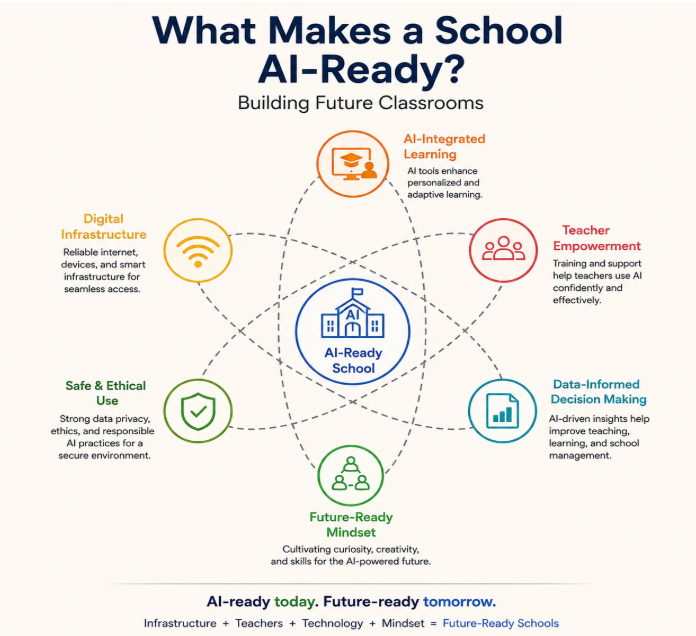
An AI-ready school uses AI strategically to improve the teaching and learning experience, with the aim of integrating technology in education to complement it rather than replace human interaction. The aim should be not to use AI everywhere, but to use it where it creates meaningful value for students, teachers, and school administrators.
An AI-ready school has five key characteristics:
– reliable digital infrastructure
– teachers who are confident in using AI tools
– AI integrated in the curriculum in ways that add value
– Ethical and responsible use of AI
– committed to continuous learning and improvement.
Technology Alone Cannot Build a Future Classroom
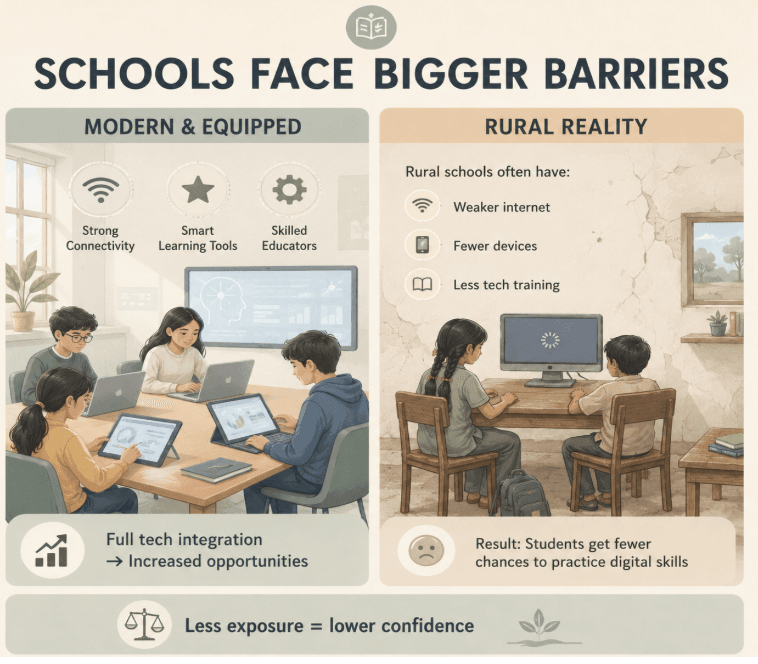
A common misconception is that a school becomes “future-ready” after it has set up computer labs, smart boards, tablets or AI-powered software. However, these technologies are only a small part of a proper education.
The report by Peepul India highlights that one of the big barriers to implementing AI education is teacher readiness. If schools aim for AI to change the classroom environment, it is important to train or provide assistance to teachers to effectively utilise this new technology.
Teachers are the backbone of any classroom, and without proper teaching ability, even the most advanced digital infrastructure and the best new technology will not help students succeed. Technology can support education, but teachers remain the driving force behind meaningful classroom experiences.
Teachers Are the Heart of AI-Ready Schools
One of the misconceptions about artificial intelligence (AI) is that it will eventually replace teachers. But in reality, AI is designed to support teachers, not replace them when used appropriately.
According to IBM Research, the goal of human-centred AI is to “design AI solutions that augment human capabilities” rather than replacing human decision-making. This means that artificial intelligence can help teachers plan lessons, design quizzes, evaluate performance, and complete other tasks, but it does not take over other responsibilities. Teachers continue to do the jobs that only humans can do, such as motivating their students, connecting with them, resolving classroom challenges, encouraging creativity, and providing mentorship. The human qualities remain at the centre of effective education.
Similarly, Adobe highlights that before building future-ready classrooms, we must first begin with building future-ready teachers. This means providing educators with the tools and training they need to develop AI literacy. They should be able to use and evaluate AI-generated material and advise students on using AI responsibly and effectively. UNESCO’s AI Competency Framework for Teachers also emphasises that educators need competencies not only to use AI tools effectively but also to evaluate AI-generated content critically and apply ethical principles in classroom practice.
Therefore, investing in teacher development is just as important as investing in technology.
AI Literacy: A New Essential Skill
Being AI-ready does not only mean being able to use an AI chatbot. Students need to be educated about how AI technologies work, what their strengths and limitations are, and how to use them responsibly. Some of the essential AI literacy skills are:
– Learning how to formulate prompts to get the most accurate responses from chatbots
– Cross-checking the information provided by AIs against reliable sources
– Understanding that sometimes AI may generate incorrect or biased answers
– Learning about being responsible regarding personal information, data privacy, and responsible sharing of information.
– Learning about plagiarism, copyright, and academic integrity.
These skills are important to help students use AI thoughtfully and not become overly reliant on it for every answer. Recognising this need, UNESCO recommends that AI literacy should include not only technical understanding but also critical thinking, ethical awareness and responsible use of AI.
How AI Can Help Students Learn Better
One of the greatest strengths of AI is its ability to personalise education.
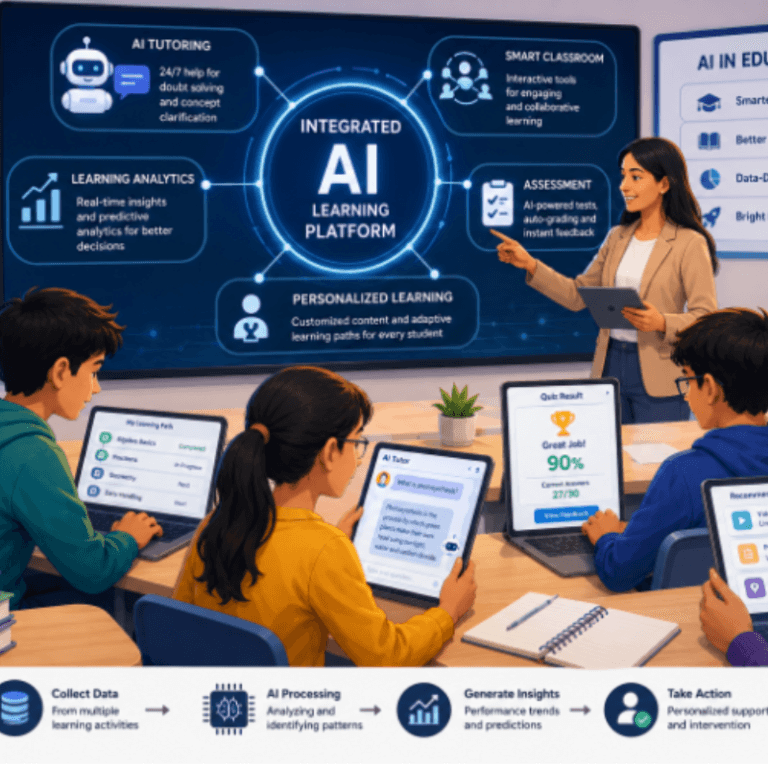
Traditional classrooms often teach at the same pace, which does not suit every student, as every learner has different speeds, strengths, and learning needs. By implementing AI learning programs, students can get personalised assistance in areas they need it most while allowing them to move at their own pace in subjects they are already skilled at.
Other benefits of AI in the classroom include:
– Adaptive learning systems
– Automated quizzes and assessments with reviews and immediate feedback
– Learning analytics that help teachers identify students who need extra assistance
– Speech-to-text and translation software
– AI-powered tutors that allow students to practice outside school hours
These systems do not replace teachers; instead, they complement traditional teaching by providing additional support, timely feedback and data-driven insights for both students and educators.
Real Examples of Progress in India
India has already taken important steps towards AI-ready education.
The Central Board of Secondary Education (CBSE) introduced Artificial Intelligence as a Skill Subject for Classes VIII–XII, encouraging schools to build computational thinking, problem-solving and responsible AI practices from the secondary level.
The National Education Policy (NEP) 2020 also encourages the introduction of technologies, digital literacy, coding, and experiential learning in schools so that students can be prepared for future careers.
Another promising project is Shiksha Copilot – an AI assistant developed for government school teachers in Karnataka. During its pilot program, the tool was tested by teachers to plan lessons, create classroom activities, and save time on administrative tasks. By doing so, the project highlighted the importance of supporting teachers in their work with AI assistants instead of replacing them.
These examples show how India is taking important steps toward AI-enabled education through practical, teacher-focused implementation rather than relying only on technology.
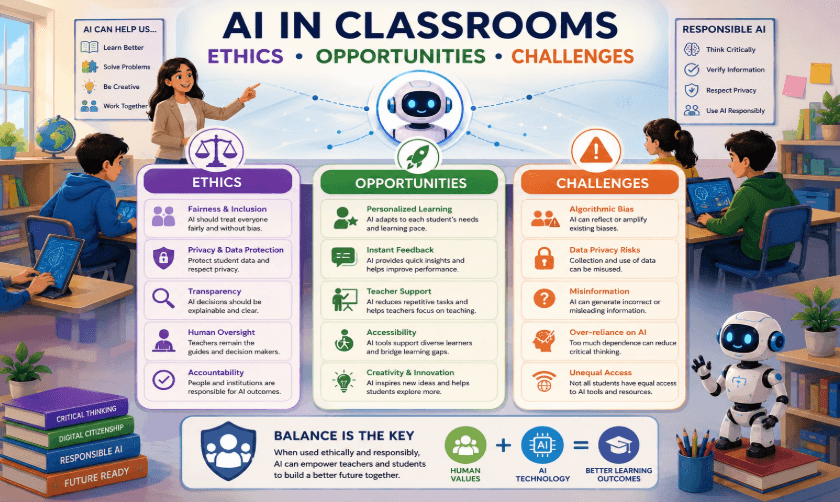
Ethics Must Be at the Centre of AI Education
As artificial intelligence becomes more common in the educational system, responsible use of the technology becomes a growing concern.
AI systems can sometimes produce misleading information, reflect bias present in training data, and generate content that sounds convincing but has incorrect information. Therefore, students should be encouraged to question and verify information produced by AI using trusted resources instead of accepting every response as a fact.
Schools should also implement clear guidelines regarding:
– Appropriate use of AI for assignments
– Academic integrity and plagiarism
– Data privacy and cybersecurity
– Human review of AI-generated content
– Responsible use of AI tools
Teaching students how to think critically about AI is just as important as teaching them how to use it.
Building Future Classrooms
Preparing a school for an AI-ready future is not a one-time investment; it is an ongoing process.
Schools can start by:
– Providing regular AI-related training and professional development courses for teachers.
– Improving internet connectivity and overall digital infrastructure
– Introducing an AI-integrated curriculum for different subjects
– Encouraging project-based, inquiry-based, and collaborative learning
– Implementing ethical guidelines for AI usage in classrooms
– Collaborating with academic institutions, industry professionals, and EdTech companies for continuous improvement and innovation
These steps help to build a truly effective educational environment where AI-assisted learning is used to its fullest potential without compromising the importance of human interaction in education.
Conclusion
The future classroom will not be dominated by robots teaching lessons and replacing teachers. Instead, a balance between technology and human expertise will allow for a more enriched education experience.
An AI-ready school would focus not only on developing the right infrastructure but also on preparing teachers and students while fostering a culture of ethical AI use. AI has the potential to personalise learning, automate routine tasks and support teachers in delivering more effective instruction. However, a human teacher can spark interest in subjects and promote students’ creativity and ability to think for themselves.
With AI and technology being integrated into education, schools that practice the responsible use of both will lead and prepare their students to learn and be successful with this new generation of knowledge.
Categories
Recent Post