How Schools Can Measure the Impact of STEM and Robotics Program

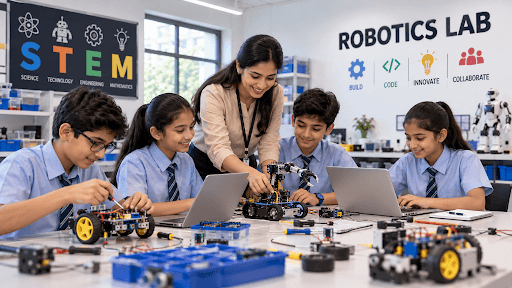
STEM education helps students explore Science, Technology, Engineering, and Mathematics through practical activities, experiments, and problem-solving.

Impact of STEM and Robotics Programs

As schools introduce robotics kits, coding activities, and AI learning programs, an important question arises: how can they determine whether these initiatives are achieving their intended learning objectives?

Counting the number of kits purchased or projects completed does not provide the complete picture. Schools also need to understand what students are learning, which skills they are developing, and how effectively teachers are implementing the program.

A structured assessment approach can help schools measure progress, identify challenges, and improve their STEM education initiatives.

1. Evaluate Student Understanding

The first step is to assess whether students understand the concepts introduced during STEM lessons.

For example, after a robotics activity, teachers can ask students to explain how a sensor works, why a motor moves, or how a program controls a robot.

Schools can use short quizzes, worksheets, demonstrations, and oral questions to assess conceptual understanding.

Comparing students’ performance before and after a learning unit can also help teachers identify changes in understanding.

2. Assess Practical Skills Through Projects

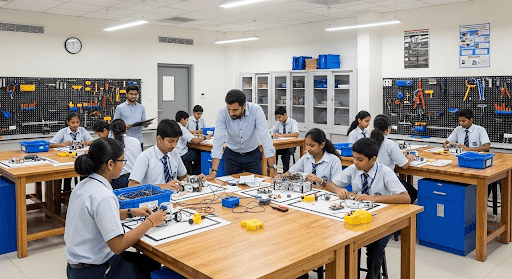
Hands-on projects provide opportunities to observe how students apply their knowledge. Teachers can evaluate students based on:
  • Ability to assemble components correctly.
  • Understanding of programming logic.
  • Problem-solving and troubleshooting.
  • Ability to test and improve a prototype.
  • Explanation of how the project works.

For example, when students build an obstacle-avoiding robot, teachers can assess not only whether it moves but also whether students understand how its sensors and program control its behaviour.

3. Measure Student Participation and Engagement

Regular participation is an important indicator of whether students are receiving opportunities to practise their skills.

Schools can track attendance in STEM sessions, participation in activities, project completion, and involvement in group discussions.

Teachers can also collect student feedback to understand which activities students find useful or challenging.

However, engagement should be considered alongside learning assessments rather than treated as proof of academic improvement on its own.

4. Evaluate Teacher Preparedness

Teachers play a central role in delivering successful STEM programs.

Schools should assess whether educators can operate the equipment, explain key concepts, conduct practical activities, and guide students through common technical problems.

Useful indicators include teacher training completion, confidence in conducting lessons, regularity of STEM sessions, and feedback on learning resources.

Ongoing training and support can help teachers deliver activities more effectively.

5. Use a Structured STEM Assessment Framework

A simple assessment framework can help schools track progress consistently.

Assessment area

What to measure

Conceptual understanding

Knowledge of science, electronics, and coding concepts

Practical skills

Ability to build and operate projects

Problem-solving

Troubleshooting and improving designs

Collaboration

Teamwork and communication

Participation

Attendance and involvement in activities

Teacher readiness

Training, confidence, and lesson implementation

Schools can use assessment rubrics, project portfolios, and periodic reviews to monitor these areas.

Where possible, establish baseline measurements before a program begins and review progress at regular intervals. This makes it easier to identify improvements and areas requiring additional support.

6. Turn Assessment Results Into Improvements

Collecting data is useful only when schools use it to improve teaching and learning.

If students struggle with programming concepts, teachers may introduce more guided exercises. If equipment is frequently unavailable, school management may need to improve lab scheduling or inventory management.

Similarly, feedback from teachers can help schools identify training needs, while project assessments can highlight topics that require additional practice.

Regular reviews help schools make informed decisions about curriculum planning, teacher development, and future investments.

Conclusion

Measuring the impact of STEM and robotics education requires more than counting completed projects or purchased equipment.

Schools should evaluate student understanding, practical skills, problem-solving, participation, and teacher preparedness. A structured assessment framework helps educators understand what is working and where improvements are needed.

By combining practical assessments with regular feedback and program reviews, schools can build more effective STEM learning experiences and give students meaningful opportunities to apply their knowledge.

Strengthen STEM Learning at Your School With STEMLearn.AI

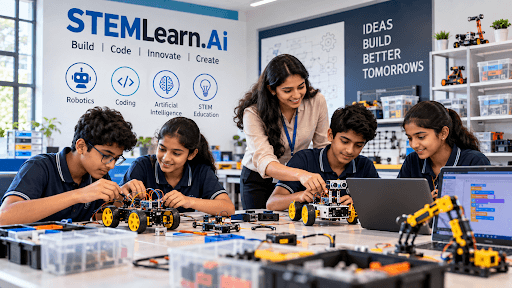
STEMLearn.AI supports schools in introducing practical learning experiences through robotics, coding, Artificial Intelligence, and STEM education.

With structured learning activities and hands-on projects, schools can create opportunities for students to explore technology, develop problem-solving skills, and apply classroom concepts in practical settings.

Interested in developing a structured STEM learning program for your school? Explore STEMLearn.AI’s educational programs and learning solutions.


Categories

Recent Post

Impact of STEM and Robotics Programs
How Schools Can Measure the Impact of STEM and Robotics Program
Project-Based Learning vs Traditional Learning
Project-Based Learning vs Traditional Learning: What Works Best for STEM Education?
Without Prior Coding Experience
How Teachers Can Introduce Artificial Intelligence Without Prior Coding Experience
Identify
Identify Your School's Learning Objectives

Register Your Interest