How AI, Robotics, and STEM Learning Are Transforming Modern Classrooms
The classroom of today looks very different from the classroom many of us grew up in.
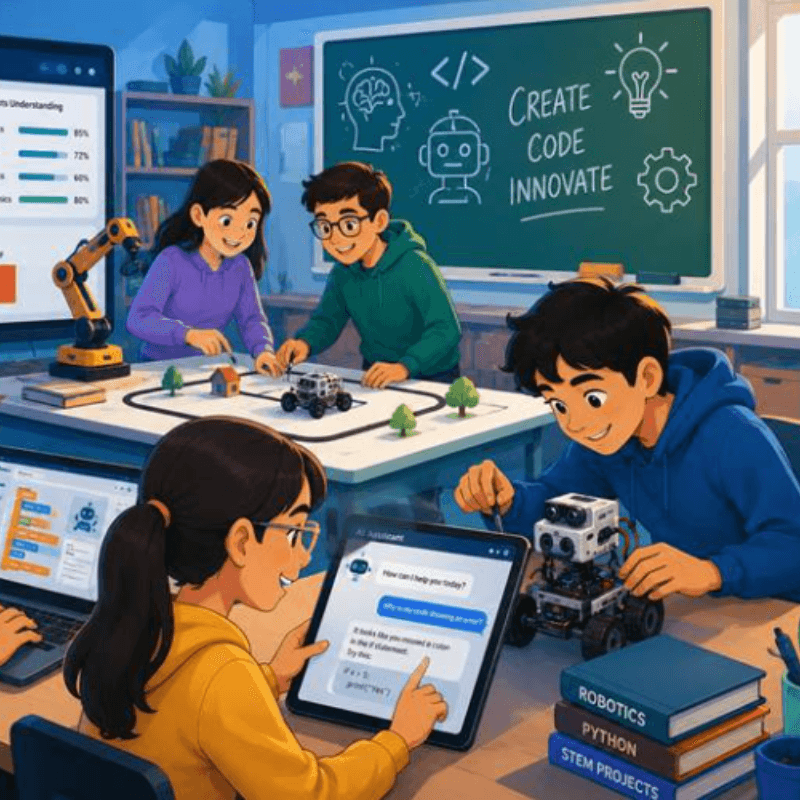
In one corner of the room, a group of students is programming a robot to avoid obstacles. Nearby, another student is asking an AI-powered chatbot why their coding project is showing an error. At the same time, a teacher is reviewing a live performance dashboard to understand which concepts students found difficult during the lesson.
What once felt like science fiction is now becoming a reality in schools around the world.
Education is experiencing a major transformation. Traditional teaching methods built around textbooks, lectures, and written exams are now being enhanced with intelligent technologies that make learning more interactive, personalized, and practical.
At the center of this transformation are Artificial Intelligence, Robotics, and STEM education. Through smart classrooms, AI-powered learning tools, robotics labs, and hands-on STEM activities, schools are evolving into spaces where students do more than just memorize information — they explore, experiment, and innovate.
But how exactly are these technologies changing the way students learn and teachers teach?
The Rise of Smart Classrooms
For many years, classroom learning followed a simple structure: teachers explained concepts, students took notes, and exams measured understanding later.
While this system worked for decades, it often overlooked one important reality — every student learns differently.
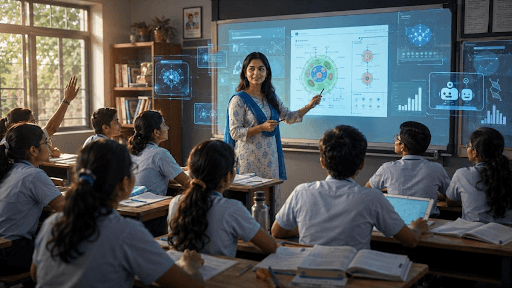
Today, schools are introducing AI-powered classroom tools and digital learning platforms that help teachers create more engaging and adaptive learning experiences. These systems assist educators in lesson planning, tracking student performance, and identifying learning gaps in real time.
Instead of waiting until final exams to understand whether students have learned effectively, teachers can now use AI learning analytics to monitor student progress continuously. Smart dashboards provide insights into topics students struggle with the most, allowing teachers to revise concepts immediately before learning gaps become larger problems.
Technology in education is no longer viewed as a distraction. It is becoming an essential support system that improves both teaching and learning.
Robotics Makes Learning Practical
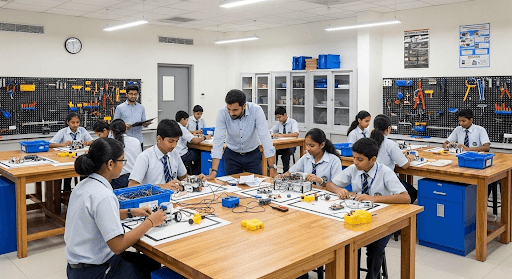
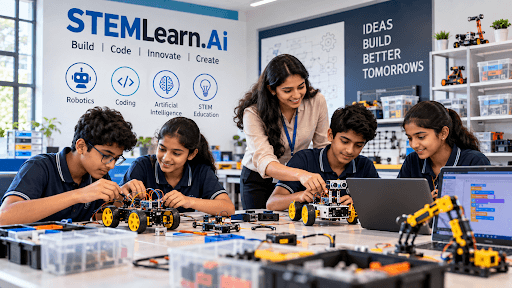
One of the most exciting developments in modern education is the introduction of robotics labs.
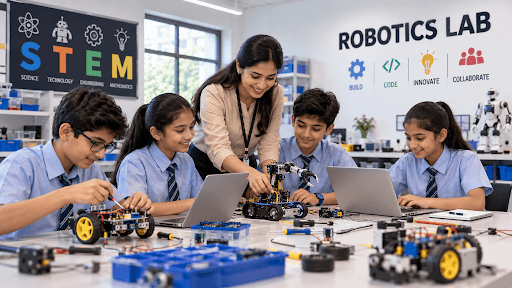
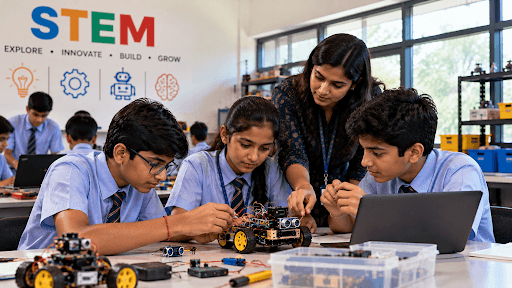
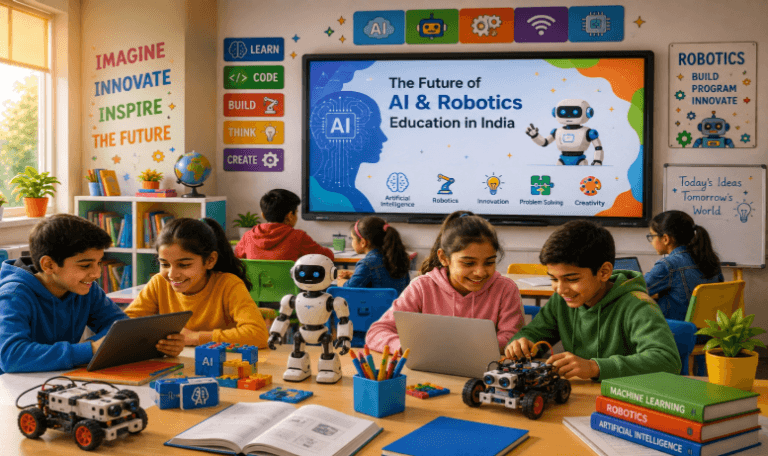
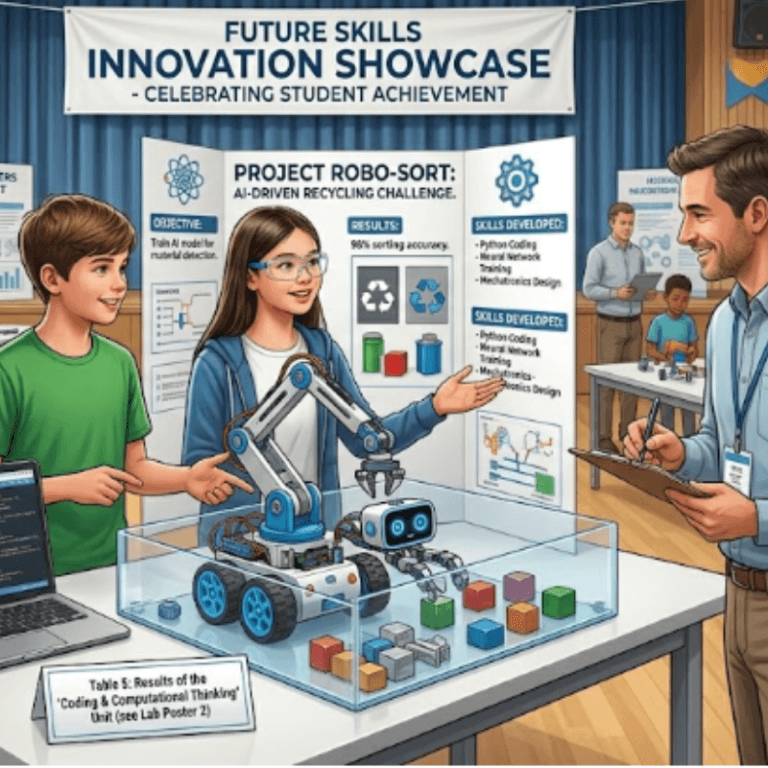
Robotics transforms classroom learning from theoretical concepts into hands-on experiences. Instead of simply reading about science and engineering principles, students can build, program, and test their own robotic models.
When students assemble components, write code, and watch their robots respond to commands, learning becomes more meaningful and memorable. Complex ideas such as automation, sensors, coding logic, and engineering design suddenly become easier to understand because students can see them in action.
Robotics also teaches students an important lesson: failure is part of learning.
A robot rarely works perfectly on the first attempt. Programs contain coding errors. Sensors may not respond correctly. But through troubleshooting and experimentation, students learn how to solve problems independently and improve their ideas step by step.
Robotics education helps students develop valuable future-ready skills, including:
- Logical thinking through coding and programming
- Problem-solving while debugging errors
- Creativity through design and innovation
- Teamwork and collaboration during group projects
- Persistence and resilience through trial and error
When students are given the opportunity to create something with their own hands, learning becomes exciting instead of routine.
Artificial Intelligence as a Learning Companion
Artificial Intelligence is also becoming a powerful learning assistant for students.
Many schools are now integrating AI tutoring systems and educational chatbots that provide support even outside classroom hours. Students can ask questions, revise difficult concepts, and receive instant explanations whenever they need help.
For example, if a student struggles with a mathematics problem or coding concept while studying at home, an AI learning assistant can immediately provide explanations, examples, and practice exercises.
Some schools are also experimenting with Custom GPTs and AI study assistants designed specifically for education. These systems adapt explanations according to a student’s learning level and pace, making difficult subjects easier to understand.
Importantly, these technologies are not replacing teachers. Instead, they are acting as additional learning support tools that help students become more confident and independent learners.
Benefits of AI Learning Tools
- Instant doubt solving through AI chatbots
- Personalized explanations based on student understanding
- Extra practice for difficult topics
- Learning support beyond school hours
- Increased confidence in asking questions and exploring concepts
Understanding Students Through Learning Analytics
Another major advantage of AI in education is the ability to understand student learning behavior through data.
Every digital activity — watching educational videos, completing quizzes, attempting assignments, or revising topics — creates useful learning insights.
Using AI-powered learning analytics platforms, schools can identify:
- Which topics students spend the most time on
- Where students commonly make mistakes
- Which lessons require revision or additional explanation
- How quickly students complete learning activities
Predictive analytics in education can even help teachers identify struggling students at an early stage. If multiple students are repeatedly facing difficulty in a particular concept, teachers can immediately intervene and improve classroom understanding before the issue grows bigger.
These insights allow educators to combine teaching experience with real-time data, creating smarter and more effective learning environments.
Smarter Assessments in the Digital Age
Technology is also reshaping the way schools conduct assessments.
Creating question papers and evaluating student performance traditionally required a significant amount of time and effort from teachers. Today, AI-powered assessment tools can generate balanced tests within minutes.
Teachers can enter topics, learning objectives, and difficulty levels, while AI systems automatically create structured question papers.
Modern AI assessment platforms are also introducing adaptive testing systems. These systems adjust question difficulty according to student performance during the assessment itself.
If a student answers correctly, the system gradually increases complexity. If the student struggles, the difficulty level decreases to identify where conceptual understanding becomes weak.
This creates assessments that evaluate true understanding rather than simple memorization.
Personalized Learning for Every Student
Every student learns at a different pace.
Some students quickly understand new topics, while others need additional explanations and practice. In traditional classrooms, addressing these differences for every student can be difficult.
This is where personalized learning powered by AI becomes highly valuable.
Modern AI learning platforms can analyze student progress and provide customized recommendations based on individual performance. Advanced learners can receive more challenging tasks, while students needing extra support can access simplified explanations and additional practice activities.
As schools integrate learning platforms with assessment systems and analytics tools, education is becoming more student-centered than ever before.
Instead of forcing every student to learn in exactly the same way, technology now allows learning experiences to adapt to individual needs.
Preparing Students for the Future
Today’s students are growing up in a world shaped by automation, artificial intelligence, and rapidly evolving technology.
Future careers will require creativity, problem-solving, coding skills, critical thinking, and innovation. Schools must therefore prepare students not only to consume technology but also to build and understand it.
Hands-on STEM learning, robotics projects, and AI-based education help students develop these future-ready skills through practical experiences.
As students begin creating their own technology projects, their confidence, curiosity, and interest in learning increase significantly.
The classroom is no longer limited to memorizing information from textbooks.
It is becoming a space where students design, experiment, invent, and explore.
A New Culture of Learning
Perhaps the biggest transformation happening in education today is not technological — it is cultural.
Students are no longer passive learners.
They are creators, innovators, explorers, and problem-solvers.
Teachers are no longer limited to delivering lectures. With the support of AI tools and learning analytics, educators can better understand student needs and guide learning more effectively.
Schools that combine AI, robotics, and STEM education are creating environments where curiosity and creativity thrive together.
And that is often where the deepest learning happens.
Conclusion
Education is evolving faster than ever before.
Artificial Intelligence, Robotics, and STEM learning are transforming classrooms into spaces filled with creativity, collaboration, experimentation, and innovation.
Through AI learning platforms, robotics labs, smart assessments, adaptive learning systems, and real-time analytics, schools can now create learning experiences that are interactive, meaningful, and personalized for every student.
Teachers gain valuable insights to improve learning outcomes, while students gain tools that encourage exploration, critical thinking, and confidence.
The purpose of these technologies is not to replace traditional education or teachers. Their purpose is to enhance learning and prepare students for a future driven by technology and innovation.
In the classrooms of tomorrow, success will not be measured only by how much students remember.
It will be measured by how well they can think, create, solve problems, and imagine new possibilities
Categories
Recent Post