
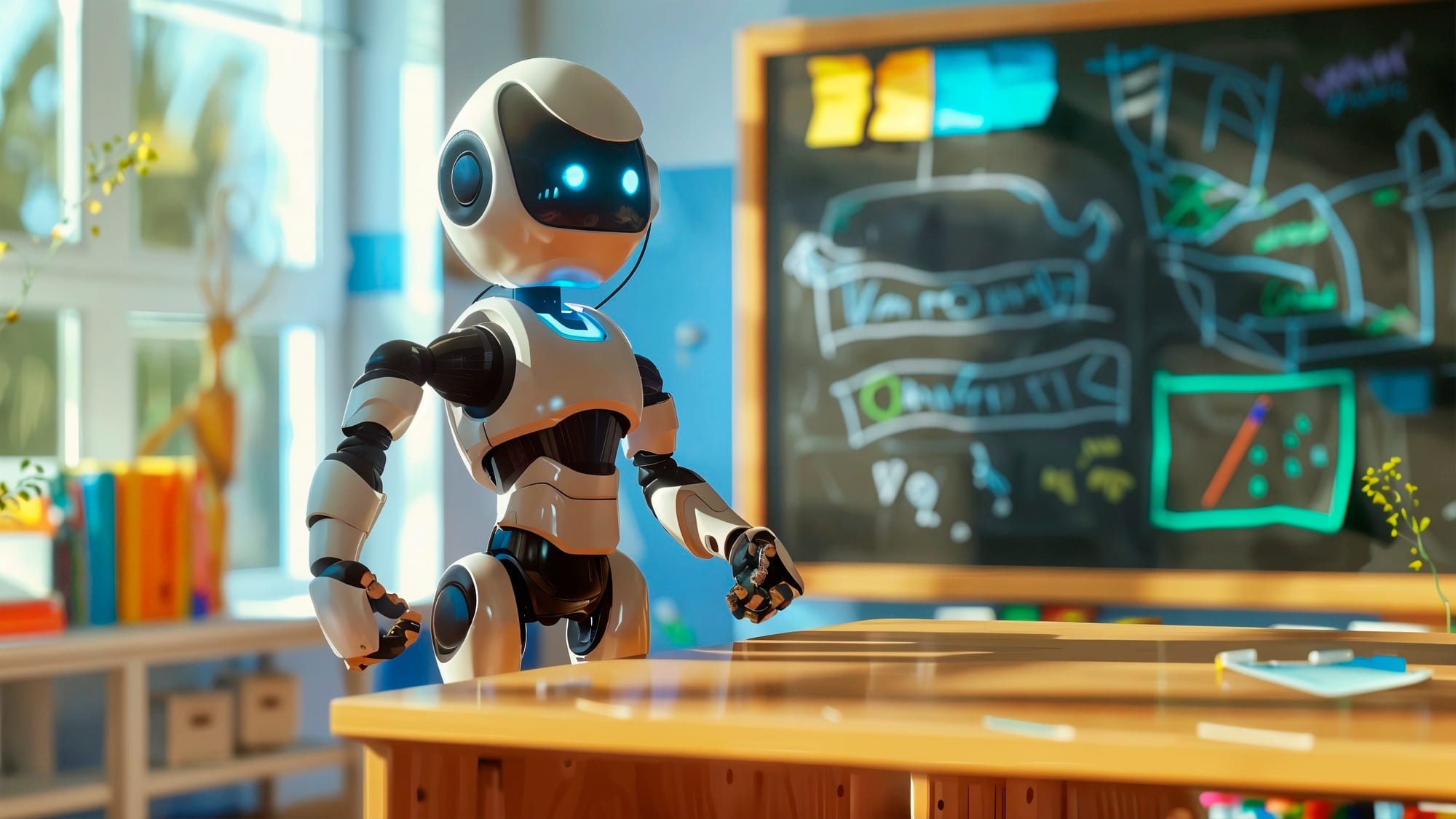

Robotics & AI – Grade 3
Level: Preparatory Stage
- 5K+ Registered Students
- 50+ Hands-on Projects
- 30+ Live Sessions
Program Overview
-
NEP 2020 Aligned STEM Curriculum
Comprehensive, grade-wise lesson plans, projects, and resources aligned with national education frameworks to foster experiential learning.
-
Hands-On & Project-Based Learning
Practical lab activities, real-world simulations, and engaging projects designed to build problem-solving and innovation skills.
-
Expert-Led & Adaptive Learning
Live, interactive sessions led by experienced STEM trainers, supported by adaptive pathways and techno-books for guided, personalized learning.
-
21st Century Skills Development
Focus on creativity, logical reasoning, critical thinking, teamwork, and communication, preparing students for future academic and professional success.
-
Experiential & Hands-On Learning
Students learn by building and experimenting with models, making abstract ideas concrete and memorable.
-
Visual & Interactive Teaching Aids
Videos, simulations, and interactive experiments simplify complex concepts and enhance retention.
-
Project-Based Learning (PBL)
Each module culminates in projects that encourage creativity, design thinking, and problem-solving.
-
Storytelling & Contextualization
Robotics and AI are introduced through relatable stories and everyday examples, helping children connect technology with real life.
-
Personalized & Adaptive Guidance
Small group and 1:1 learning ensures that every child progresses at their own pace with focused attention.
-
Playful Exploration & Collaboration
Games, puzzles, and group activities create a joyful learning environment while fostering teamwork and innovation.
Our Methodology
- 30+ interactive live sessions (45–60 minutes each, teacher-led and highly engaging)
- 50+ hands-on activities & virtual simulations with real-world application
- 20+ storytelling & design-based projects that connect concepts to practice
- STEM Lab setup & techno-books with QR-based interactive content and resources
- Activity-based & project-based assessments to track progress and improvement
- Exploration of AI & robotics in everyday life through simple, age-appropriate applications
- Progressive learning pathways covering mechanical builds, sensor integration & AI-powered simulations
- National-level SparkX Innovation Challenge to showcase creativity, teamwork, and problem-solving
Goals that we achieve through the program
STEM Foundation
- Build a Strong STEM Base
- 50+ Hands-on Activities
- Learn basics of machines, motion, and simple circuits
- Develop Early Engineering Thinking
Creativity & Collaboration
- Spark Creativity & Imagination
- Design and Build “Dream Robots”
- 30+ Team Projects and Wonder Challenges
- Enhance Communication & Teamwork
AI Awareness & Growth Mindset
- Gain Early Awareness of AI in Daily Life
- 10+ Design Thinking Activities
- Develop Problem-Solving and Logical Thinking
- Build Confidence through Making & Experimenting
Our Curriculum
| Session | Chapter Name | Project | Concepts Covered |
|---|---|---|---|
| 1 | Robots: The Smart Machines! | Draw Your Dream Robot | Learn the difference between machines and robots, understand where robots are used |
| 2 | The Spinning Wind Tower! | Make a Motorized Windmill | Explore wind energy, motor mechanisms, build a functional rotating model |
| 3 | The Smart Toll Plaza Gate! | Make a Motorized Toll Gate | Understand automation, sensors & motors, model real-world systems |
| 4 | The Walking Wonder | Build a Walking Robot | Learn motorized movement without wheels using mechanical linkages |
| 5 | The Slow & Smart Snail Robot | Make a Snail Robot | Explore motion via vibration/motor friction, test simple robot construction |
| 6 | Electricity on the Go! | Build a Power Generator | Generate electricity using mechanical energy, understand backup power |
| 7–8 | Build Your Own Wonder – I | Robot Without Wheels | Design a functional robot, test ideas using linkages, troubleshoot designs |
| 9–10 | Build Your Own Wonder – II | Expandable/Lifting Bridge | Apply robotics to real-world issues, use motors and linkages to solve tasks |
| Session | Chapter Name | Project | Concepts Covered |
|---|---|---|---|
| 1 | Lighting Up with Circuits | Create an Electric Circuit to Light an LED | Circuit basics, closed vs open circuit, LED connection |
| 2 | Circuit Adventures: The Role of a Switch | Light up an LED Circuit Using a Switch | Switch control, current flow, simple circuit building |
| 3 | Spinning Fun – Understanding Outward Force | Create a Horse-Riding Card Activity | Spinning motion, centrifugal force, creativity |
| 4 | Optical Magic with Shapes | Create a Spinning Shape Illusion | Optical illusion, 2D–3D connection, visual perception |
| 5 | The Amazing Wonder Mixer | Create Your Own Wonder Mixer | Motor power, air movement, energy transfer |
| 6 | The Floating Magic! | Create a Floating Magnet | Magnetic repulsion, levitation, engineering design |
| 7–8 | Build Your Own Wonder – I | Design a Working Model of a Carnival Swing Ride | Design thinking, teamwork, creativity |
| 9–10 | Build Your Own Wonder – II | Design a Glowing City, Magical Vehicle, or Enchanted House | Innovation, problem-solving, collaborative design |
Testimonials
Ankit Kumar
Afzal Siddiqui
Ravi Kumar
Frequently Asked questions
The FAQ section provides quick answers to common questions, helping users find information easily and save time.
Do you have questions?